
S-03 Solutions · Festivals and large events
Weather holds and show stops, answered by every crew member.
Orders reach staff tags and phones across an open site while the crowd's phones fill the cell network, and each answer returns to the production office by name.
For: festival production, site operations, security and medical leads, and the unified command post on show days.
01 The site-ops gap · example: Grant Park, Chicago
When the storm cell arrives, the network is already full.
Crowds this size
About 115,000 people a day attended Lollapalooza in Grant Park in 2025. In a 2012 storm, more than 60,000 people were cleared from the park.
Radio and text fall short
Radio is one shared channel. Texts and apps ride a cell network that is already at capacity.
The result
Production calls a stop and cannot see which gates and stages have it.
Sources: Fox 32 Chicago, 2025 (115,000 a day); Pollstar, August 10, 2012 (more than 60,000 evacuated). Grant Park is used as a public example; no relationship with the festival is implied.
02 A weather stop Simulated site plan
STOP to 2,500 staff across the park, and every tap counted.
- 01
Stop sent
Production arms STOP and sends it to every stage, gate and medical team.
- 02
Tags and phones
Tags and the festival app show it, with cell assumed jammed.
- 03
One press
Crew answer; tags cover crew, volunteers and contractors without a company phone.
- 04
Gaps by area
Production sees names by area, who is silent, and the reason.
- 05
Re-send, record
Only the silent get it again. The record is kept for the debrief.
03 Deployment Simulated
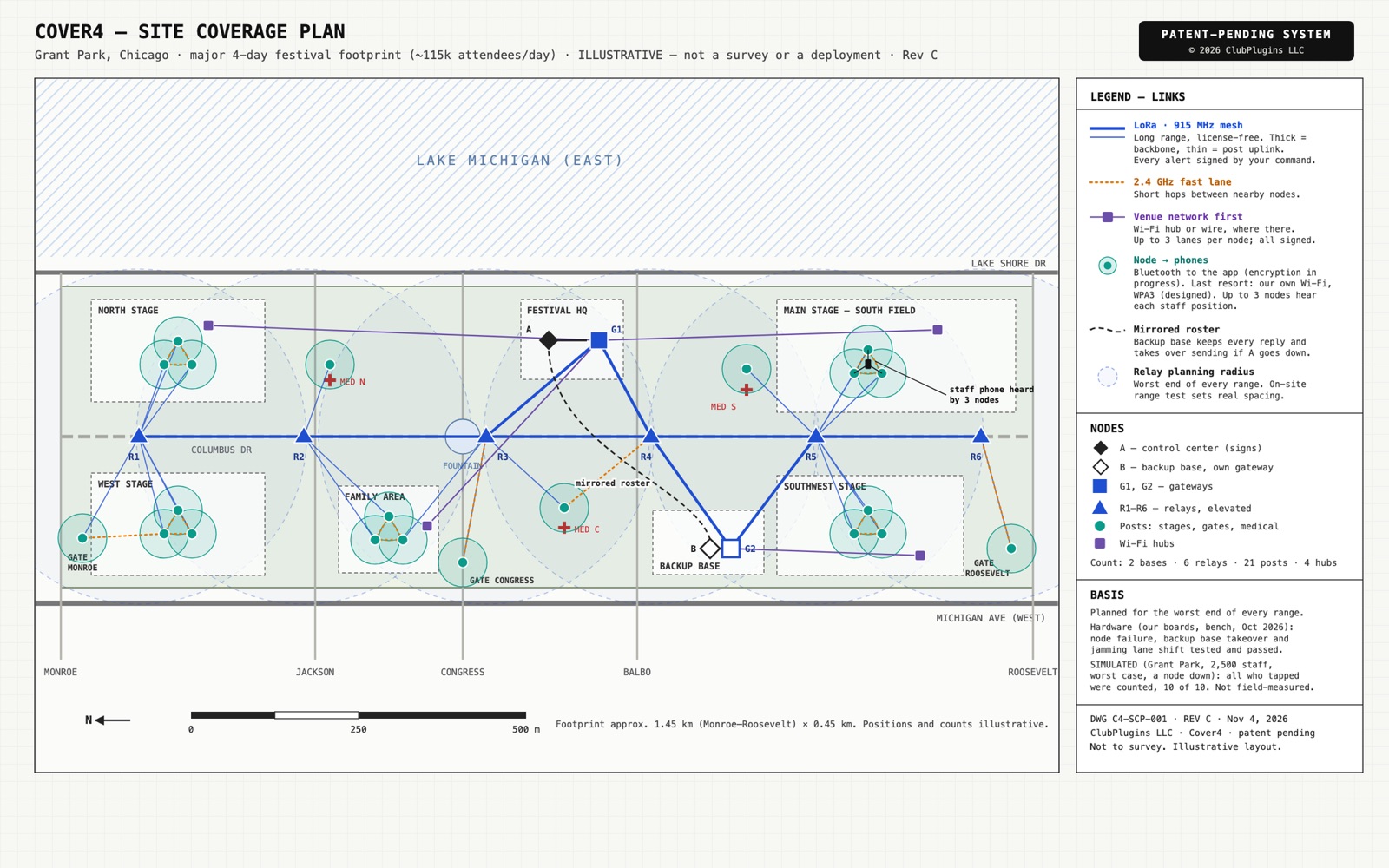
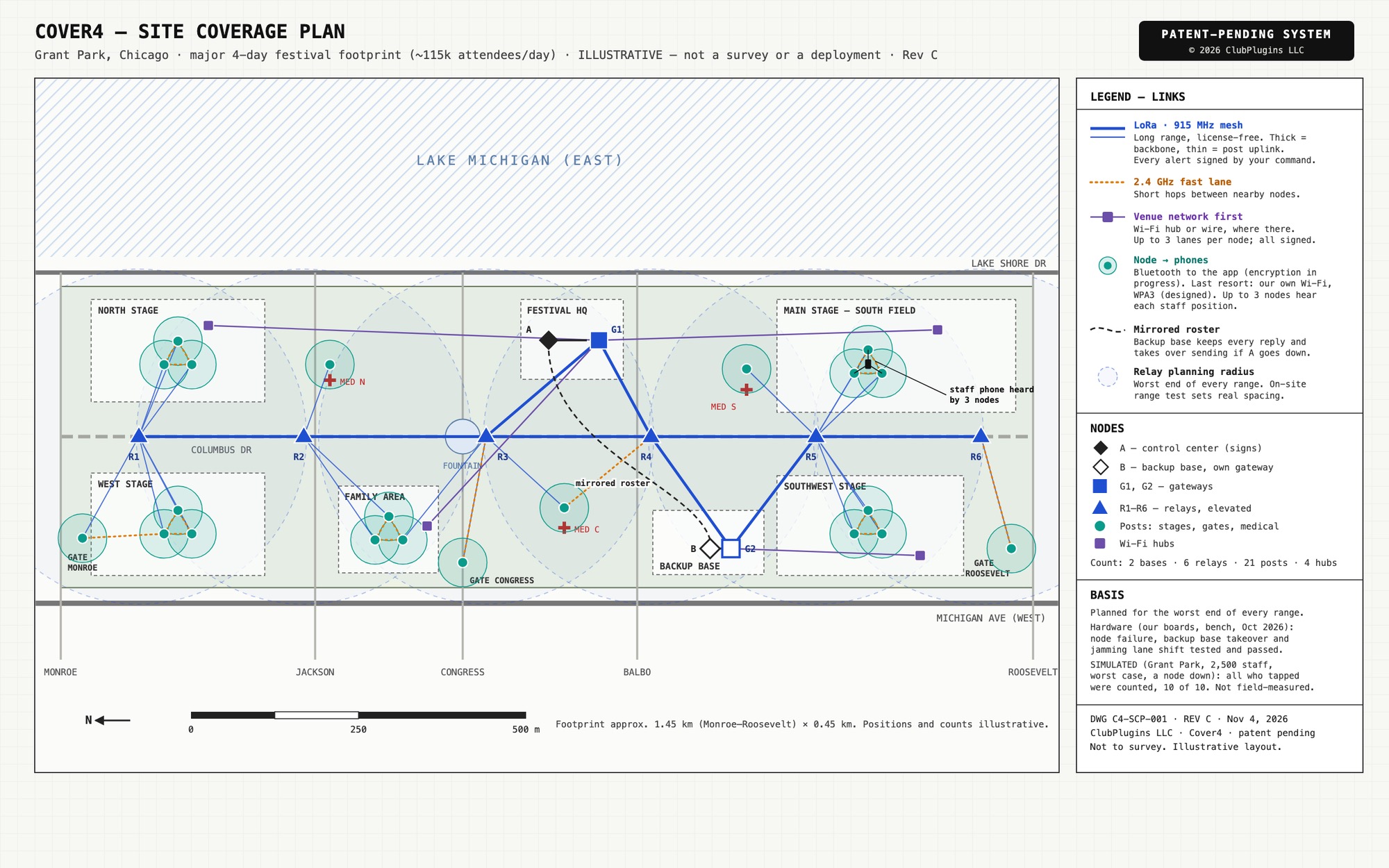
A temporary kit: 18 send nodes, three receiver clusters, laptops for control.
| Scenario | Grant Park footprint, 100,000 attendees, 2,500 staff each carrying a tag |
|---|---|
| Send nodes | 18, on battery at stages and gates, wired where the site has a network |
| Receiver clusters | 3, of 8 receivers each |
| Wi-Fi hubs | 5, for staff calls and video only; alerts never go through a hub |
| STOP reaches staff tags | 90% within 0.39 s, 99% within 1.11 s, the last within 4.45 s |
| Tap to control center | Typically 3.6 s, 99% within 7.1 s, slowest 18.6 s |
| Taps counted | 24,232 of 24,232 over 10 runs; 53,412 tag transmissions, 0 collisions |
| One cluster lost 30 s after the STOP | Still 0 uncounted; 99% within 11.7 s, slowest 46.7 s |
| Test conditions | Every radio link 20 dB worse than the planning model, a node failing during the event, noise bursts, no staff phone answering |
| Site simulator, 10 runs, worst run shown. Simulated, not measured. Cluster placement assumed at existing elevated posts; the model is not yet calibrated against a venue walk. | |
04 What you keep, what Cover4 adds
The show-stop procedure stays yours. Cover4 shows who has the order.
You keep
- Radios as the voice tool for every department.
- Your PA, show-stop and evacuation procedures, and screens.
- Your crew or festival app: Cover4 runs inside it through the SDK, or on the Cover4 crew app for a pilot.
- The site network where there is one; Cover4 does not depend on it.
Cover4 adds
- Orders to a stage, a zone, a role or a person, not only everyone on one channel.
- A by-name count at the production office within seconds.
- HELP with a typed message, placed at the nearest node.
- A tamper-evident record for the unified-command debrief, designed to support permit and insurer reviews.
05 Proof and security
Measured on the bench; the open site is the next test.
| Stage | Date | Result |
|---|---|---|
| Bench | 2026-10-26 | STOP confirmed by name in 3.1–4.6 s on phones never paired and with Wi-Fi off. |
| Bench | 2026-10-30 | All nodes hopped across 16 channels in step; a single-channel jammer did not stop the network. |
| Bench | 2026-11-03 | Staff replies in assigned time slots: 30 of 30 heard and acknowledged on two boards. |
| Twin | as of 2026-11-05 | Real firmware and control center with simulated radio: 199 of 200 pre-registered head-count runs met the deadline. The one miss is unexplained. |
| Not yet shown | open | Open-air range at a real site. Any field event. |
Signed at your command
Every order is signed at your control center. A fake STOP or all-clear goes nowhere.
Backup command
A second control center keeps the roster and takes over sending if the first goes down.
Staff only
Staff alerts only. No attendee tracking, and no attendee-to-attendee messaging. Security details
- Open-air range is not yet measured. The festival result above is a simulation, not a field result.
- Solar-powered outdoor nodes are planned, not built.
- Designed to FCC Part 15.247, not yet certified.
- On iPhone, a force-quit app or Bluetooth switched off stops phone alerts; the tag works on its own.
One event, walk-tested before the gates open.
One stage or one staff zone at one event, with tags for gate, stage and medical crews and a walk test the day before. You receive the by-name confirmation record, a coverage map of the zone, and the node count we would plan for the full site.
partners@getcover4.com