
S-02 Solutions · Arenas
Orders confirmed by name across the bowl, the concourse and back of house.
On a sold-out night the crowd saturates the building's cell and Wi-Fi, and the staff who must act on a hold or an evacuation are spread across sections, entrances, loading docks and corridors. Cover4 puts the order on every staff tag and phone at once and shows the event-control desk who has it.
For: arena operations, security and event-control teams running concerts, games and changeovers in one building.
01 The event-night gap
Inside concrete and steel, the order has to reach people the network does not.
The crowd takes the network
On a full night, cell service and venue Wi-Fi are the first networks to saturate, which is exactly when a stop, hold or evacuate order has to land.
Concrete costs signal
Our one concrete roof-edge walk measured about 35 dB more loss than the planning model at that spot; a relay placed at the door fixed it.
The result
Event control cannot show which entrances, sections and back-of-house posts received the hold.
Roof-edge walk: Cover4 bench log, measured on our boards. Placement matters, and a walk test at your building sets it.
02 An evacuation during changeover Illustrative
One EVACUATE to every team on shift, and the names of anyone silent.
- 01
Arm and send
Event control holds EVACUATE to arm it and sends to all staff, or to one level, one entrance or one team.
- 02
Every tag
Tags alert on their own, so ushers, concessions and dock crews do not need a venue phone.
- 03
One press
Each answer returns by name: acknowledge, I'm safe, or I need help.
- 04
Escalate the gaps
Anyone not confirmed by the deadline is listed with the last node that heard them, and the order is re-sent only to them.
Illustrative walk-through of features shown on our bench; not a field event.
03 Deployment Simulated
A handful of send nodes, mounted high, and at least three receiver clusters.
| Venue model | An NBA and NHL arena on its public outline (United Center, Chicago) |
|---|---|
| Send nodes | Simulated minimum 3 at the worst end; planned 4 (the minimum plus a spare) |
| Receiver clusters | At least 3, our rule for every venue, with a fourth where the knockout test asks for one |
| Staff devices | One tag per staff member; the phone is optional |
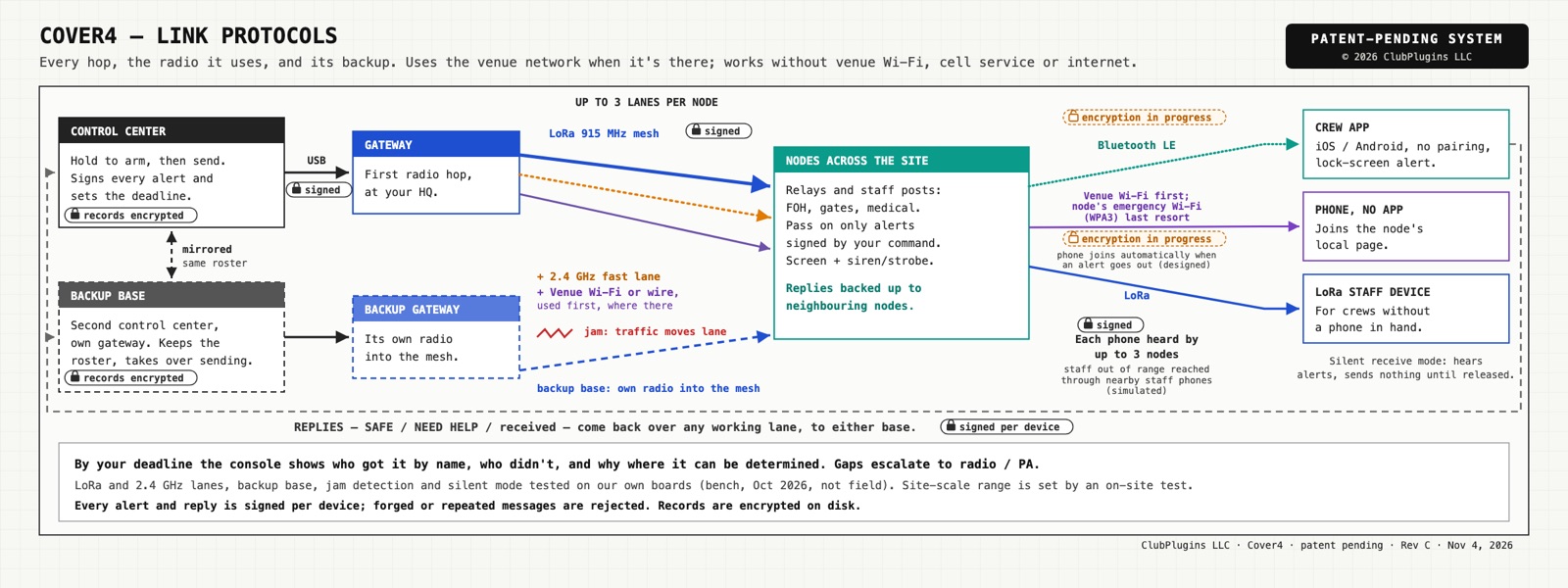
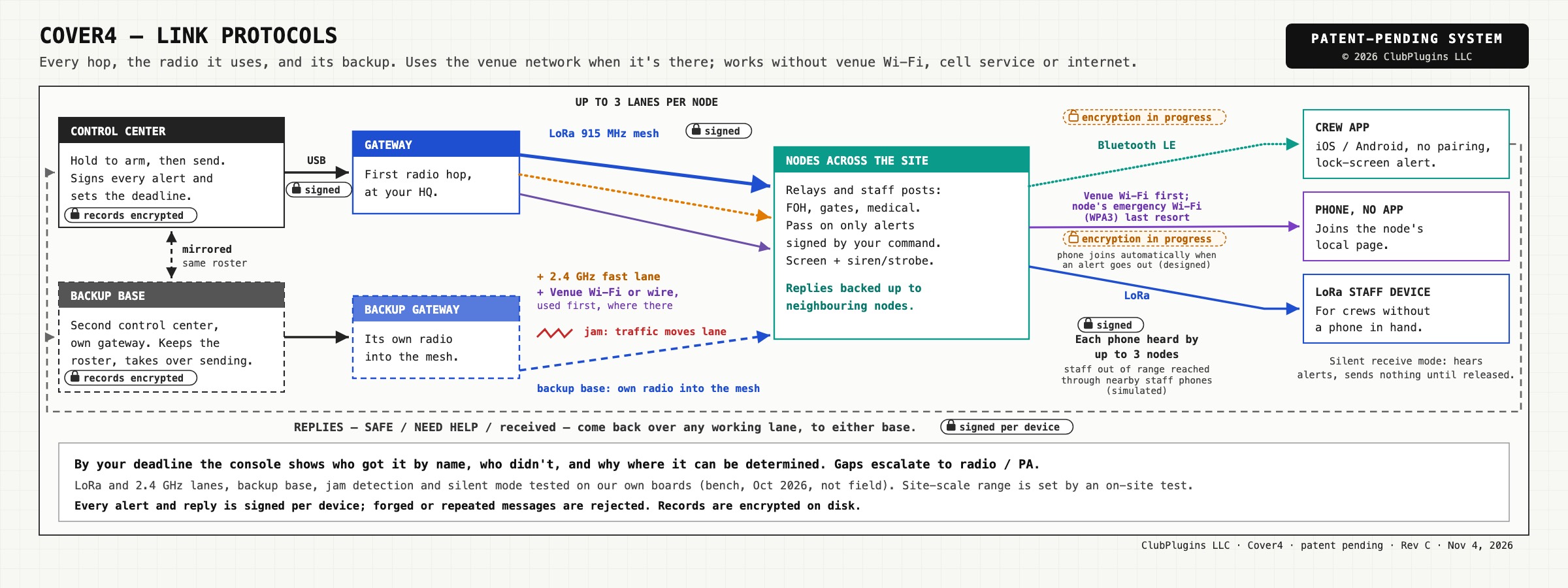
| Network | The building's wired network first, powered over Ethernet where available; Cover4's battery radio network as backup |
| Test conditions | Every radio link 20 dB worse than the planning model, no staff phone answering, one send node down, any one receiver cluster down |
| Send-node sweep, site simulator, worst end. Simulated, not measured. The outline is a public venue model; no relationship with the venue is implied. A range test in the building comes before any node count is quoted. | |
04 What you keep, what Cover4 adds
Nothing is ripped out. Staff learn one new action.
You keep
- Your radios and channels for talk, and your event-control procedures.
- Your PA, voice evacuation system and fire alarm.
- Your staff app, if you run one: Cover4 can sit inside it through the SDK.
Cover4 adds
- Orders to one level, entrance, team or person, as well as everyone.
- Confirmation by name, with anyone missing flagged and the reason given.
- HELP with a typed message, placed at the nearest node.
- A backup control center that takes over if the primary stops.
- A tamper-evident record for the post-event review and the insurer.
05 Proof and security
Failures we have already forced on the bench.
| Stage | Date | Result |
|---|---|---|
| Bench | 2026-10-29 | A relay died right after taking a reply; another relay delivered it, confirmed by name at 16 s. |
| Bench | 2026-10-29 | Primary control center killed: the backup took over in 15 s and re-sent to the 5 unconfirmed. |
| Bench | 2026-11-01 | Phone Bluetooth off: the staff tag alerted on its own and its signed confirmation was counted. |
| Simulated | 2026-11-05 | 110 major-league venues, including NBA and NHL arenas: all 51 NBA and NHL arenas counted every tap with 3 receiver clusters after any single cluster loss, 3 runs per venue. |
| Not yet shown | open | Any arena walk or event. |
Only the site can send
Orders are signed at your control center; devices reject anything the site did not sign.
No names on air
Replies travel with per-event codes. Names resolve only at your control center.
HELP is encrypted
HELP messages and operator replies are encrypted end to end. Security details
- Not yet field-tested. The arena plan is simulated and the model is not yet calibrated against a venue walk.
- Designed to FCC Part 15.247, not yet certified.
- On iPhone, a force-quit app or Bluetooth switched off stops phone alerts; the tag works on its own.
Walk the building, then run one event.
We walk the arena with your operations and security leads, place nodes where the walk says, and run one event or one zone beside your radios. You receive the by-name record and a measured coverage map.
partners@getcover4.com